

Nebraska soybean farmers know a good rain is worth its weight in gold. And while Mother Nature delivered some much-needed moisture this spring, we’re all approaching August with the long game in mind.
Dry spells in recent years and the unpredictability of what comes next have sharpened the focus on how to work smarter with water.
“We’re in a better spot than we were at this time in years prior, like in 2023,” said Bruno P. Lena, PhD, water and cropping systems assistant extension educator with Nebraska Extension. “But if that rainfall doesn’t keep coming, we’re going to start seeing damage in our dryland fields.”
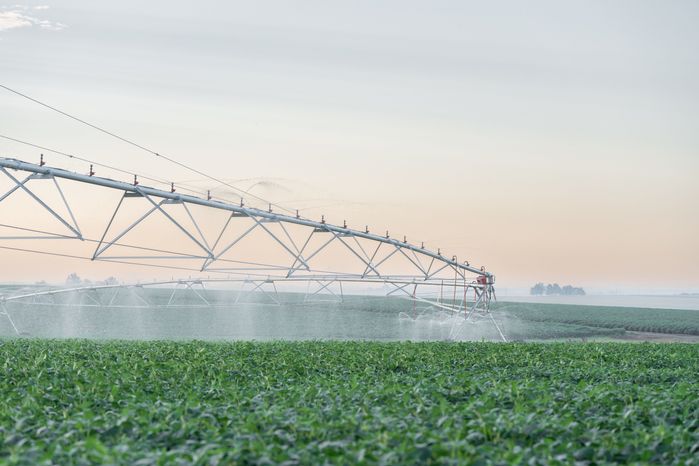
Across east-central Nebraska counties like Boone, Platte and Nance, recent storms helped recharge the soil profile. For now, many fields are at adequate soil moisture down to about three feet. That’s a relief for farmers who have watched the drought monitor bounce between moderate and severe classifications the past few seasons.
Still, Lena warns not to get overly optimistic. “Dryland farmers are in a position where there’s just not much you can do. If you’re on a light-textured soil like sandy soils that have low soil water holding capacity, and rain doesn’t come, you’re going to start seeing some signals of water stress. But in fields with clay or clay loams, water stress signals will take longer to occur.”
That contrast makes knowing your field’s natural advantages and limitations key. And it explains why irrigation, when available, is as much an art as a science.
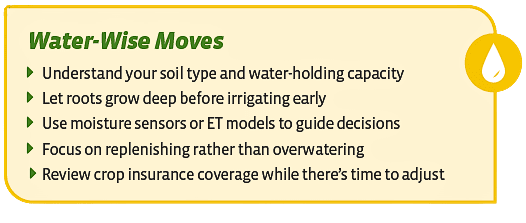
“In a typical mid- to late-July, soybeans use about two inches of water per week,” Lena said. “If you’re irrigating, it’s all about matching that crop water demand at the right time without overdoing it. The goal is to let the roots chase moisture during spring and then step in before stress hits.”
The most sensitive time, of course, is pod fill. Strategic farmers wait to water until the soil nears its depletion threshold, then replenish just enough to keep the crop healthy. Too much too early can actually weaken root development.
That’s why Lena encourages growers to lean into data, not just routine.
Technologies like crop evapotranspiration (ET) models and soil moisture sensors are giving farmers real-time insights into when and how much to irrigate. “They take the guesswork out of it,” Lena said. “Some on-farm research studies showed that you can save an inch or more of water per field, without hurting yields.”
Being strategic is not just good for a farmer’s bottom line, it’s good for the entire community. “One inch of irrigation water on a 130-acre field equals about 3.5 million gallons,” Lena said. “If every farmer saved just one inch, that’s enough to supply water to a small town for a day.”
Even with a modest upfront cost, the payoff adds up quickly. In 2024, on-farm trials across four Nebraska fields showed that growers using irrigation scheduling tools saved an average of 1.2 inches of water—1.5 inches on corn fields and about 0.9 inches on soybeans—compared to their standard practices. Importantly, yields and net returns remained statistically the same.
One Platte County grower used just 3.5 inches of irrigation for the entire 2024 season by relying on soil sensor data. The approach drew attention from his neighbors and the local Natural Resources District (NRD), proving that precision pays off when the conditions are right.
Dryland farmers may not have those levers to pull, but they aren’t powerless. Crop insurance remains one of the few tools in their belt to guard against risk. Many choose Revenue Protection plans with 75 to 85 percent coverage. Others layer on options like ECO or SCO for added peace of mind, though those come with added costs. It’s always wise to consider your options and consult with trusted insurance professionals. That, along with an understanding of your soil and geography, can set the tone for resilience when the skies stay dry.
“It’s one thing you can control when you can’t control the weather,” Lena said. “And when paired with a good understanding of your soil and location, it gives you a better chance at staying resilient.”
Ultimately, July decisions set the tone for the rest of the season. Investing in smart water strategies, staying informed through tools like the UNL Drought Monitor and weekly forecasts, and leaning on Extension educators can all help reduce stress when the skies dry up.
As Lena puts it, “The more rain, the better. But the more we understand what’s happening in the soil, and use that to guide our choices, the more likely we are to come out ahead.”
I see a lot of folks who want to keep the pivot running just to be safe. But with today’s irrigation scheduling tools, you can know when it’s truly needed so you’re not wasting water and money.” - BRUNO P. LENA, PHD, WATER AND CROPPING SYSTEMS ASSISTANT EXTENSION EDUCATOR, NEBRASKA EXTENSION