

Stretching from Nebraska to North Carolina and Michigan to Mississippi, ten U.S. farmers who have started careers in production agriculture recently journeyed to Honduras and Guatemala. As part of United Soybean Board’s See for Yourself mission, the group experienced an in-depth look at the soy checkoff’s investments in international market growth. With about 60% of the U.S. soybean crop exported, in addition to value-added poultry and meat products traveling overseas, these next-generation U.S. farmers experienced the global impact of U.S. soybeans.
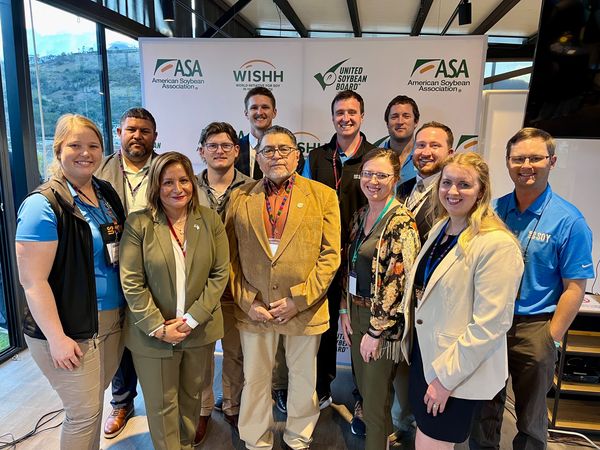
Livestock, and Food Maynor Estrada and Foreign Agricultural
Service (FAS) Agriculture Counselor Marcela Rondon for Guatemala,
Honduras, El Salvador, and Belize, at the World Initiative for
Soy in Human Health Food Security Dialogue.
“With these U.S. soybean farmers across several states contributing to the soy checkoff, this mission allowed them to see firsthand how their investments grow export markets,” said Philip Good, USB Chair and farmer from Mississippi. “Not only that, but better understanding how the ports and infrastructure affect U.S. Soy products internationally and the importance of the Panama Canal were critical to the discussion. Whether it was seeing poultry and egg products fed U.S. soybean meal or the Soy Excellence Centers equipping soy professionals with practical skills, the global footprint of U.S. Soy made a lasting impression with this group.”
Guatemala is the 15th-largest market for U.S. agricultural exports, according to the Foreign Agricultural Service, and with Honduras sourcing a vast majority of its soybean meal demand with U.S. product, Central America serves a critical market for U.S. farmers. During the mission from Feb. 1-9, the See for Yourself participants met with Guatemala’s Minister of Agriculture Maynor Estrada. They also visited Guatemala’s largest port, Terminal De Granos Del Pacifico, which services more than 50 million bushels per year and imports 80% of country’s food and livestock product. In addition, the mission comprised visits with feed manufacturers, egg producers and food companies using soy protein.
The farmers attending posted daily blogs and videos, and Cale Buhr from Inland, Nebraska who was a participant on the mission shared:
“I joined the See for Yourself mission to become a walking testimonial for the soy checkoff and share my experience with farmers back home who aren’t fully aware of what the checkoff does,” said Nebraska farmer Cale Buhr. “Not only that, but now I can highlight different partnerships and how they maximize the money we pay into the checkoff with certain investments. This mission aims to develop the next generation of farmer leaders, and someday, I hope to put my name in the ring to be on the United Soybean Board.”
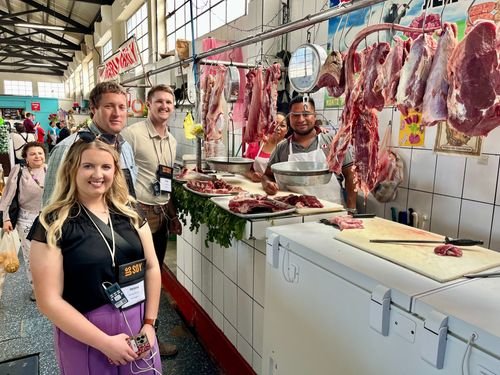
Mercado Villa de Guadalupe in GuatemalaCity.
The USA Poultry and Egg Export Council hosted the visit
to showcase meat fed with U.S. soy. Guatemala is Central
America's largest market for U.S. soybean meal and oil.
The mission included presentations from soy checkoff partners the U.S. Meat Export Federation (USMEF), the USA Poultry and Egg Export Council (USAPEEC), the American Soybean Association’s World Initiative for Soy in Human Health (WISHH) and the U.S. Soybean Export Council (USSEC). The participants learned about USSEC’s partnership in Honduras with El Zamorano University on its Soy Excellence Center. In addition, the group heard from the Food and Agriculture Organization of the United Nations and USDA’s Foreign Agricultural Service about trade in the region and global agrifood challenges at WISHH’s Food Security Dialogue.
Upon returning from the mission, Buhr presented his experiences to the Nebraska Soybean Board at its March 10-11 meeting in Lincoln. He highlighted key takeaways from the trip, including the importance of partnerships in expanding markets, the necessity of sustainability as a benchmark rather than a trend, and the significance of every market, big or small, for U.S. soy. Buhr also emphasized the value of U.S. infrastructure in maintaining export efficiency and reinforced that the soybean checkoff is working hard to deliver results for farmers. “We need to keep up the good work to ensure a strong future for U.S. soy,” he said.
To find out more about USB’s See for Yourself program and a recap of the mission in Central America, visit unitedsoybean.org/see-for-yourself-2025.